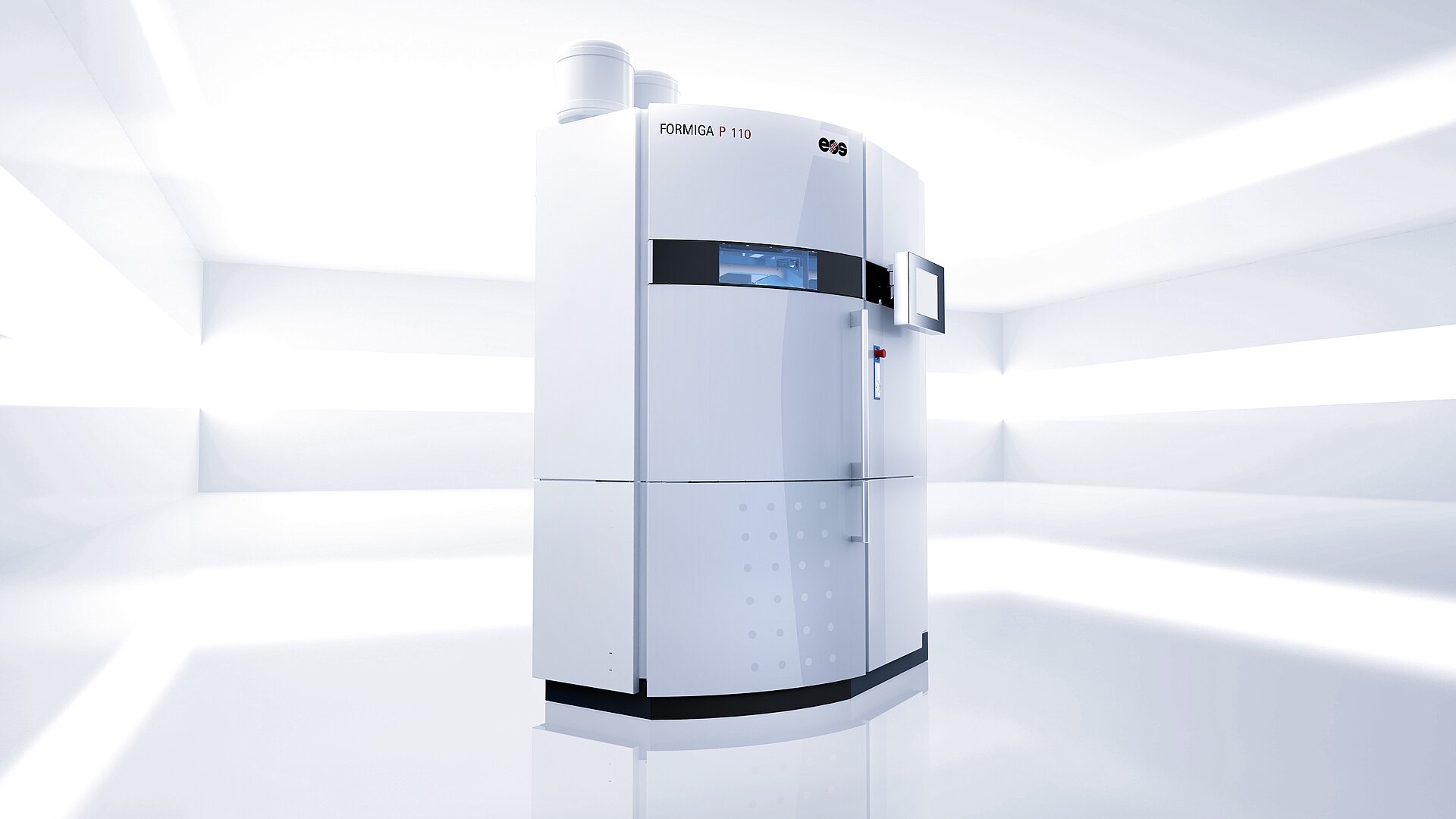
 Photo: Nicole W, CC BY-SA 4.0
What is PA12?
PA12 (polyamide 12) is an engineering plastic from the nylon family. In 3D printing it is processed as a fine powder in SLS (selective laser sintering) and MJF (Multi Jet Fusion). The result is a strong, light and tough part suitable for prototypes and end use alike.
The big advantage: PA12 parts behave like real plastic parts. They flex a little before they break, cope with repeated use and tolerate oil and grease. That's why you find PA12 in enclosures, clamps, hinges and machine parts.
Typical properties of PA12
The values below are typical ranges from common datasheets for printed PA12. They vary by machine, powder and build orientation. Use them as guidance, not as a design guarantee.
| Property | Typical for printed PA12 |
|---|---|
| Density | around 1.0 g/cm³ |
| Tensile strength | around 45-50 MPa |
| Elongation at break | around 10-20% |
| Melting point | around 175-185 °C |
| Service temperature | -40 to +80 °C |
| Moisture absorption | low compared with PA6 and PA66 |
| Chemical resistance | good against oil, grease and fuel; weaker against strong acids |
In short: PA12 is stiff enough for structural parts, tough enough not to snap and dimensionally stable because it absorbs little moisture.
SLS PA12 or MJF PA12?
In both cases the material is PA12, but the process differs. In SLS a laser fuses the powder; in MJF a print head jets a fusing agent onto the powder, then infrared heat fuses the whole layer. At Makernaut both technologies run through selected partners.
| Feature | SLS PA12 | MJF PA12 |
|---|---|---|
| Natural colour | White | Grey |
| Colours at Makernaut | White, black | Grey, black |
| Properties | Strong and tough | Strong, even in all directions |
| Strong point | White base, easy to dye | Suited to series |
Rule of thumb: choose MJF for grey or black functional parts and series, SLS if the part must be white or will later get a light colour.
Design rules for PA12
PA12 is printed in a powder bed without supports. That gives a lot of freedom, but a few rules decide whether your part comes out of the machine well and at a sensible price.
Wall thickness
A wall thickness of about 1.5 mm or more is a safe choice for sturdy walls. Thinner details around 1 mm often work but are more fragile. Don't make walls thicker than needed: thick solid blocks can warp as they cool and use more material. An even wall thickness gives the best result.
Escape holes for powder
If you hollow out a part to save material, add at least two escape holes so the unused powder can get out. A fully enclosed cavity stays filled with powder and counts as material. A diameter of at least 5 mm is often recommended; larger or longer cavities need bigger openings.
Clearances and moving parts
Because there are no supports, you can print hinges and interlocking parts in one go. Leave enough clearance between them so the powder can escape and the parts don't fuse together. A clearance of around 0.5 mm is a common starting point.
- Use ribs rather than solid walls for stiffness.
- Round off sharp inner corners to limit stress concentrations.
- Use threaded inserts for joints that are opened and closed often.
- Supply a STEP file or a watertight STL.
Finishing PA12
After printing, PA12 parts are depowdered and cleaned. They then have a matte, slightly grainy surface. If you want more, there are a few common steps. Finishing is not included in the starting price per cm³.
- Blasting: makes the surface more even and slightly smoother.
- Dyeing (dip-dyeing): gives an even colour, best on white SLS PA12. Black works on any base.
- Lacquering or spray painting: for a specific colour or extra protection.
Applications of PA12
- Functional prototypes that need real testing
- Enclosures for electronics and devices
- Clamps, brackets, grippers and fixtures in machine building
- Hinges and snap fits
- Small and medium series of end-use parts
PA12 is less suited to transparent parts, to a mirror-smooth surface without finishing, or to uses above its service temperature. Look at SLA resin or metal instead.
What does PA12 cost?
At Makernaut you can print PA12 in four variants. All prices are starting prices, per cm³, excl. VAT and excl. finishing.
| Material | Technology | From |
|---|---|---|
| PA12 Grey | MJF | €0.52/cm³ |
| PA12 Black | MJF | €0.70/cm³ |
| PA12 White | SLS | €0.65/cm³ |
| PA12 Black | SLS | €0.70/cm³ |
Worked example: a 30 cm³ clamp in PA12 Grey via MJF comes to 30 cm³ × €0.52/cm³ = from €15.60 per part, excl. VAT and finishing. Volume × material price is a starting point; you'll see your actual price in Quotebase.