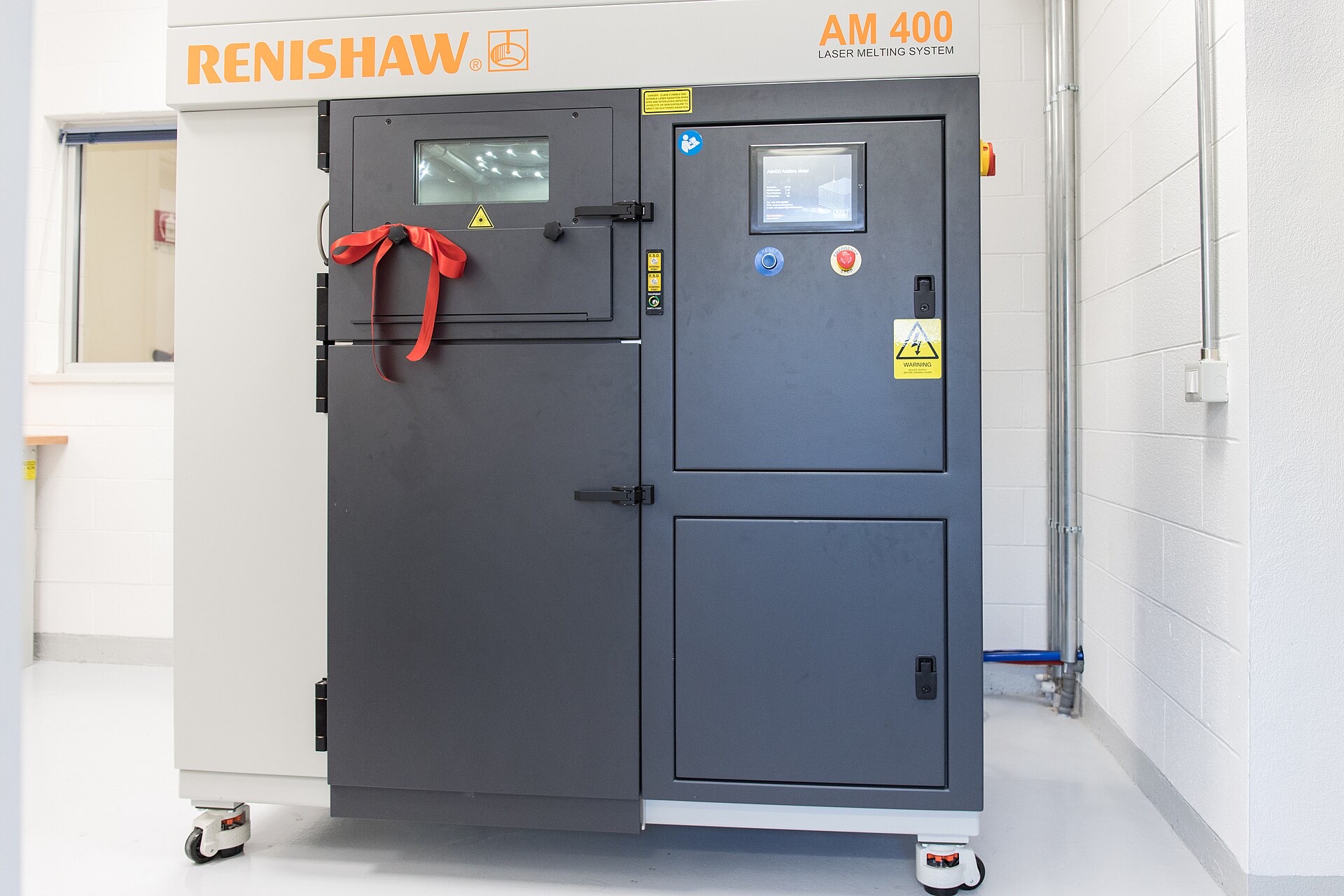
 Photo: Università di Pavia, CC BY 2.0
What is SLM?
SLM stands for Selective Laser Melting. The printer spreads a very thin layer of metal powder on a build plate. A powerful laser fully melts the powder where the part needs to be. The build plate then drops by one layer and the cycle repeats.
Because the powder genuinely melts, you get an almost fully dense metal part. That sets it apart from processes that only bind powder together. You can drill, mill, tap or polish the printed part afterwards like any other metal component.
At Makernaut, SLM is produced through selected, ISO 9001-certified partners. You upload your file to Quotebase, choose the metal and see a price straight away.
Which metals can you 3D print?
Makernaut offers three metals for SLM, each with its own strengths. Prices are starting prices per cm³, excl. VAT and excl. finishing.
| Metal | Why choose it | Typical uses | From |
|---|---|---|---|
| Titanium TC4 (Ti6Al4V) | Very strong for its weight, good corrosion resistance | Lightweight brackets, aerospace, medical prototypes, sport | €6.50/cm³ |
| Stainless steel 316L | Tough, corrosion resistant, easy to machine afterwards | Cooling channels, grippers, parts for food and chemical use | €3.99/cm³ |
| Aluminium | Light, conducts heat well | Heat exchangers, drone parts, housings | €4.50/cm³ |
Titanium TC4 or Ti6Al4V: what's the difference?
There is none. TC4 is the Chinese designation for the same alloy known as Ti6Al4V or grade 5 in Europe and the US: titanium with roughly 6% aluminium and 4% vanadium. It is the most widely used titanium alloy in aerospace and medical applications.
Titanium weighs roughly half as much as steel yet remains very strong. That's why you choose it mainly when weight matters. Combine it with an internal lattice and you remove even more weight without losing strength where the part carries load.
Binder Jetting: the alternative for metal
Binder Jetting works differently. A print head jets a binder onto a powder bed, gluing the metal particles together. The result is a fragile, unsintered part that is then sintered in a furnace into solid metal. The part shrinks during sintering; the production partner allows for that.
At Makernaut, Binder Jetting is available in 316L stainless steel, through partners. The starting price is €3.80/cm³. It needs no metal supports and suits larger quantities of small, complex parts. SLM remains the choice if you need titanium or aluminium, or want the highest density.
Design rules for metal 3D printing
Printing metal isn't plastic printing with a pricier material. The process puts a lot of heat into the part, and that shapes your design.
Supports
- SLM needs supports under overhanging faces. They hold the part and conduct heat away to the build plate.
- Make sloping faces as steep as you can. Fewer supports means less finishing and a lower price.
- Supports are removed mechanically. Make sure every support can be reached with a tool; internal channels need a self-supporting shape, such as a teardrop or diamond profile.
Wall thickness and mass
- Avoid large solid blocks: they cost more metal, more print time and build up more stress. Hollow out or use a lattice where there is no load.
- Keep walls evenly thick. Big jumps in thickness cause uneven cooling and therefore distortion.
- Hollow sections need an opening to remove the loose powder.
Finishing and heat treatment
After printing, the part usually goes through a heat treatment first to relieve internal stress. Only then is it cut from the build plate and the supports removed. The exact treatment depends on the metal and the application.
A printed metal surface is matt and slightly rough. For fits, sealing faces and threads, plan some finishing: bead blasting for an even look, and CNC milling or drilling for faces that must fit tightly. Allow a little extra material in your model for that.
Metal 3D printing or CNC machining?
A machined metal part is often cheaper than a printed one. So the question isn't which technology is better, but which suits your shape and your quantities.
| Situation | Choose |
|---|---|
| Internal channels, lattices, organic shapes | SLM |
| Saving weight in titanium | SLM |
| Merging several parts into one | SLM |
| Larger quantities of small, complex 316L parts | Binder Jetting |
| Prismatic shapes, flat faces, bores | CNC machining |
| Tight tolerances across the whole part | CNC machining (or SLM + finish machining) |
| Large, simple part | CNC machining |
A handy rule of thumb: if you can draw the part as a block you remove material from, CNC machining usually makes more sense. If its value lies precisely in a shape you can't machine, metal 3D printing pays for itself.
What does titanium 3D printing cost? Two worked examples
The price of metal 3D printing depends mainly on your part's volume and the metal you choose. Supports, finishing and heat treatment come on top. Volume × material price is therefore a starting point; you'll see your actual price in Quotebase.
Worked example 1: lightweight titanium bracket
A bracket with an internal lattice has a volume of 20 cm³. In titanium TC4 that's 20 cm³ × €6.50/cm³ = from €130.00 per part, excl. VAT and finishing.
Worked example 2: block with cooling channels in 316L
An insert with internal cooling channels has a volume of 45 cm³. In 316L stainless steel that's 45 cm³ × €3.99/cm³ = from €179.55 per part, excl. VAT. Finish machining of the functional faces comes on top.
Want to bring the price down? Reduce the volume with a lattice or hollowing, design fewer overhangs, and keep tight tolerances to the faces that really need them.
In summary
- Choose SLM in titanium when weight and strength both matter.
- Choose SLM in 316L for corrosion-resistant parts with internal channels.
- Choose aluminium when heat dissipation and low weight matter most.
- Choose Binder Jetting for larger quantities of small 316L parts.
- Choose CNC machining for simple shapes and tight tolerances.